"Called at 9 PM after finding black mold in our basement. They were here the next morning, walked us through everything, and the air smelled fresh again within days."

Attic mold from a roof leak
Attic mold from a roof leak in Minneapolis
Roof leak caused mold in your Minneapolis attic? We find the source, remove the mold, treat the sheathing, and document for insurance.
- 24/7 emergency response
- IICRC certified team
- Licensed & fully insured
- 5-star local reviews
IICRC Certified
Licensed & Insured
24/7 Emergency Service
Free Inspection
A roof leak leaves a different attic mold pattern than poor venting. In Minneapolis attics, we look for dark staining near a chimney, valley, roof vent, plumbing boot, or ice dam path, then check the roof sheathing with a moisture meter.
That matters because the repair order changes. The roof has to be fixed first, then the attic is dried, then the stained sheathing is cleaned and treated. For attic mold from roof leak Minneapolis claims, we also take photos and readings because this is often a covered insurance loss.
Leak mold shows up in one place, vent mold spreads out
A leak stain is usually local. We may see black or gray growth on one bay of roof sheathing, around a rusted nail line, below a failed pipe boot, or next to old chimney flashing. In South Minneapolis homes from the 1920s and 1930s, we often see plank roof decking with one wet area near a valley or dormer cheek wall.
Ventilation mold looks different. It tends to show as an even dusting across many rafters and the north roof deck, often worse near the eaves where bath fan air or attic bypass air has been condensing for years. The moisture readings are spread out, not just under one leak path.
During the free inspection, we compare the stain pattern with the roof condition. If the sheathing reads high near one roof penetration and dry 6 feet away, that points to a roof leak, not a whole-attic airflow problem.
The roof repair comes before attic mold treatment
Mold work should not start while water is still entering the attic. If a plumbing boot is split, shingles are lifted, or step flashing is open against a wall, that repair comes first. In winter, an ice dam leak near Lake Nokomis or Northeast can keep feeding the same plywood bay until the ice and roof edge are handled.
After the leak is stopped, we dry the attic framing and sheathing. That may mean air movement, dehumidification, and follow-up moisture readings. We do not want to seal wet wood behind a treatment.
Once the wood is dry, the affected sheathing is cleaned and treated. Replacement is rare. We look for soft decking, delamination, rot, or loss of fastener hold. If the roof deck is still sound, cleaning and treatment usually make more sense than tearing off good shingles to replace one stained panel.
Insurance documentation needs the leak story, not just mold photos
A roof-leak-caused attic mold job often has a clear date or event tied to it, like a wind-damaged shingle, hail hit, failed flashing, or an ice dam. That makes the paper trail different from long-term attic ventilation mold. We document the leak point, affected roof bay, moisture readings, and the mold growth on the sheathing.
For homeowners filing a claim, photos need to show cause and effect. A close-up of mold is not enough. We take wider attic photos, mark the wet area, note the roof feature above it, and record meter readings before and after drying.
Insurance coverage depends on the policy and the cause of loss, but attic mold from a roof leak is a common covered claim. We can share our findings with you in plain language, so your adjuster sees the order of work and why the attic needed remediation after the roof was repaired.
Our Process
How we remove mold safely, in 4 steps
No guesswork. No upsells. A clear, certified process from first call to final clearance test.
1. Call or Request Quote
Tell us what you're seeing. We respond in 15 minutes or less, 24/7.
2. Free On-Site Inspection
A certified technician inspects, tests, and identifies the source.
3. Containment & Removal
We seal off the area, remove contaminated materials, and HEPA scrub the air.
4. Clearance & Warranty
Final air test confirms safe air quality. Workmanship warranty included.
Real Minneapolis Jobs
Before & after
Local homes, real results. Every job documented with photos, lab reports, and clearance testing.
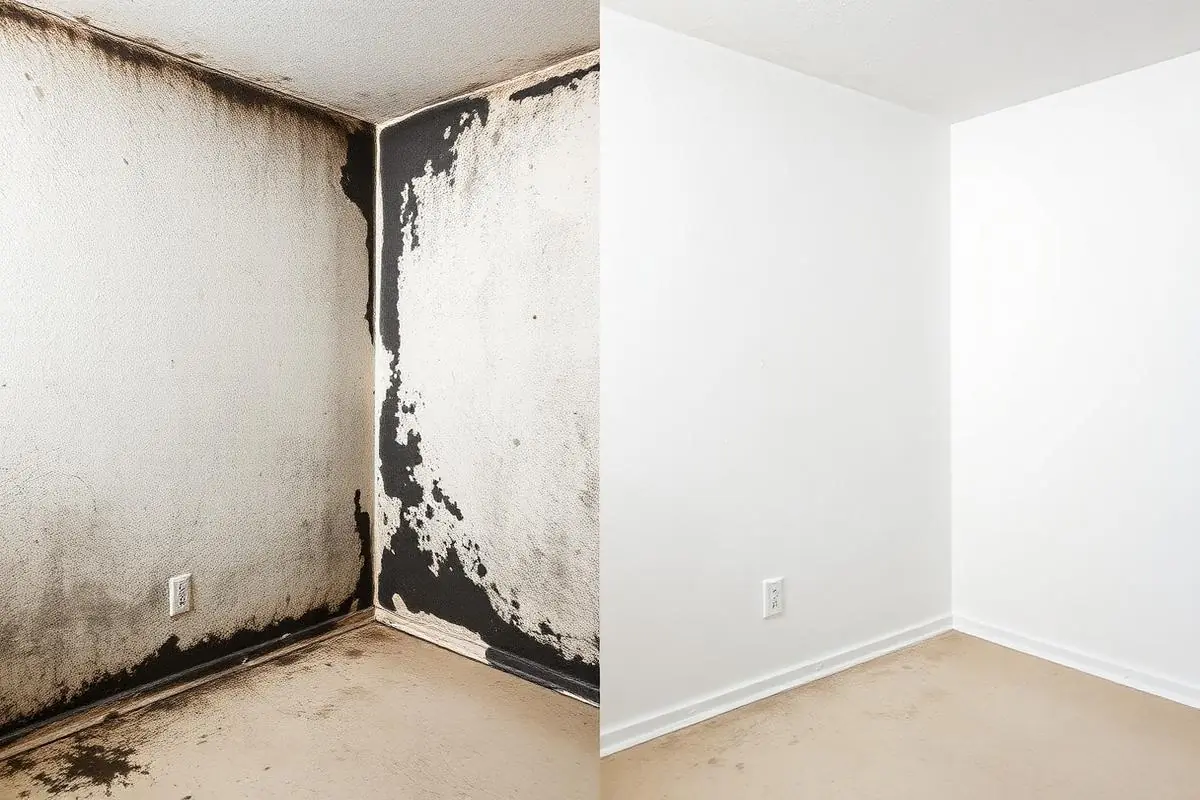
Basement drywall, South Minneapolis
Heavy mold removed and surface restored after spring flooding.
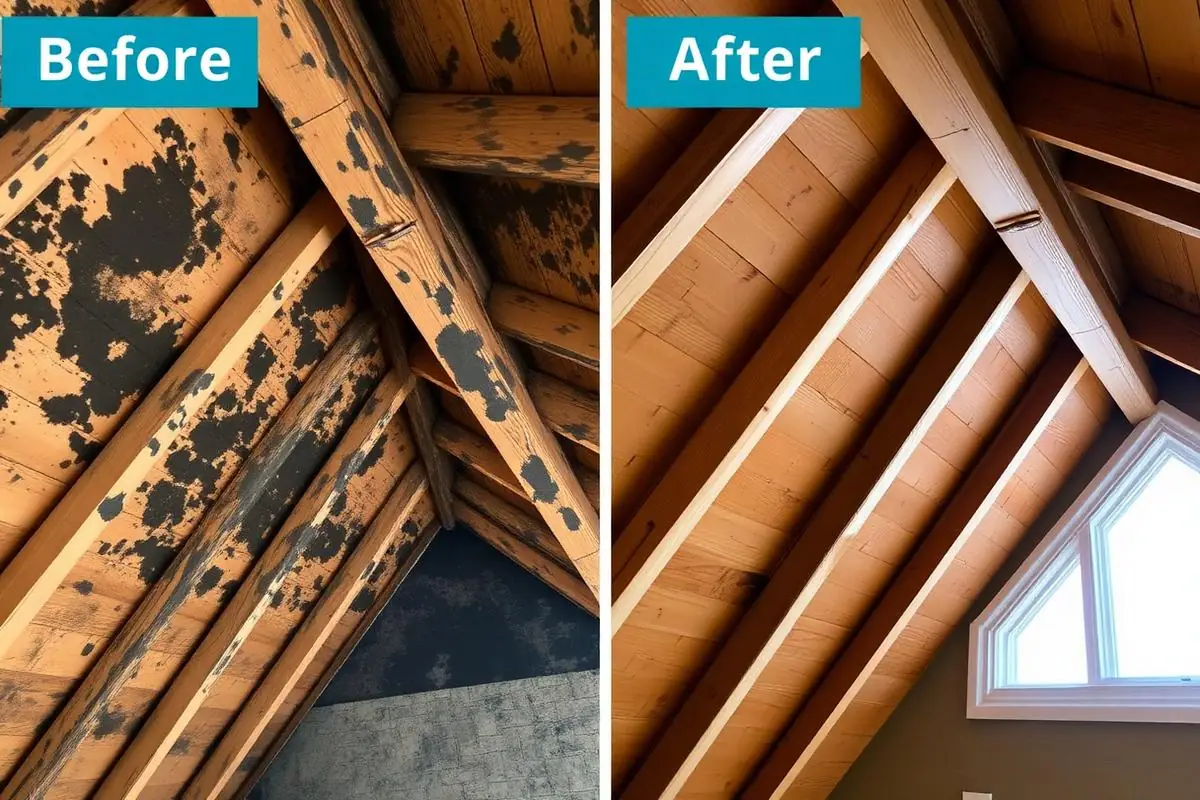
Attic sheathing, Edina
Ventilation issue corrected, sheathing treated and sealed.
5-Star Reviews
Trusted across the Twin Cities
4.9from 380+ local homeowners
"Honest pricing and no scare tactics. Other companies wanted $8k, these guys did the job properly for less than half that and showed me the lab results."
"We had attic mold from an old roof leak. The team handled insurance paperwork and the workmanship warranty gave us real peace of mind selling the house."
Service Area
Serving Minneapolis & the Twin Cities Metro
Locally owned. Same-day response across the metro, no out-of-state subcontractors, ever.
FAQ
Common questions, straight answers
How can I tell if attic mold is from a roof leak or bad ventilation?+
Leak mold is usually clustered around one roof area, like a chimney, valley, vent, or pipe boot. Ventilation mold is more even across rafters and roof sheathing, often on the north side. We confirm it with moisture-meter readings on the stained sheathing and nearby dry areas.
Can you remove the attic mold before the roof leak is fixed?+
We can inspect it, but mold treatment should wait until the roof leak is repaired. If water is still entering through flashing, shingles, or a roof boot, the wood can get wet again and the job may fail. The right order is roof repair, attic drying, then sheathing treatment.
Will the moldy roof sheathing need to be replaced?+
Most roof-leak attic mold jobs do not need sheathing replacement. If the plywood, OSB, or old plank decking is dry and still solid, we clean and treat it. Replacement is for soft wood, rot, delamination, or roof decking that no longer holds nails well.
Is attic mold from a roof leak covered by insurance in Minneapolis?+
It is often a covered claim when the mold follows a covered roof leak, like storm damage or a sudden flashing failure. The adjuster will want proof of the leak source, the affected attic area, and drying readings. We document those details during the inspection and remediation process.
Not sure where to start? Most homeowners book a mold inspection first, then move into full mold remediation once we know the scope. Want prices first? See Minneapolis mold removal cost. Specialty scopes like crawl space mold removal are common in older homes. Neighborhood pages like East Richfield, Richfield mold removal walk through what we see block by block. Suburb work starts with Minneapolis homeowners.
Browse the site
Everything we cover for Minneapolis homeowners
Pricing by job type, neighborhood-specific pages, and specialty scopes. Pick what looks like your situation.
Pricing
2026 Minneapolis mold pricing guides
Neighborhoods
Minneapolis neighborhood mold removal
- Nokomis
- Northeast Minneapolis
- Powderhorn
- Linden Hills
- Camden
- Uptown
- Kenwood
- Longfellow
- Whittier
- Loring Park
- Marcy-Holmes
- Como
- Prospect Park
- Seward
- Cedar-Riverside
- Bryn Mawr
- Fulton
- Kingfield
- Standish-Ericsson
- Windom
- Highland Park, St. Paul
- Mac-Groveland, St. Paul
- Como (St. Paul), St. Paul
- Morningside, Edina
- Country Club, Edina
- Cahill, Edina
- Elmwood, St. Louis Park
- Fern Hill, St. Louis Park
- Browndale, St. Louis Park
- East Richfield, Richfield
- West Richfield, Richfield
- Central Richfield, Richfield
- East Bloomington, Bloomington
- West Bloomington, Bloomington
- Oxboro, Bloomington
- The Preserve, Eden Prairie
- Hidden Ponds, Eden Prairie
- Bearpath, Eden Prairie
- Glen Lake, Minnetonka
- Groveland, Minnetonka
- Burwell, Minnetonka
- Bass Lake, Plymouth
- Parkers Lake, Plymouth
- Medicine Lake, Plymouth
- Arbor Lakes, Maple Grove
- Rush Creek, Maple Grove
- Weaver Lake, Maple Grove
- Cedar Grove, Eagan
- Lexington-Diffley, Eagan
- Central Park, Eagan
- Heart of the City, Burnsville
- Sunset Pond, Burnsville
- Southcross, Burnsville
- Powers Lake, Woodbury
- Wedgewood, Woodbury
- Stonemill Farms, Woodbury
- Central Park, Roseville
- Owasso, Roseville
- Langton Lake, Roseville
Specialty jobs
Specialty mold services in Minneapolis
Mold won't wait. Neither do we.
Call now for a free inspection. A certified Minneapolis technician will be at your door, often the same day.